UK ground stability by postcode
Free Subsidence Risk Postcode Checker
Enter a postcode to see whether public British Geological Survey (BGS) geology flags clay-rich, shrink-swell ground. It is a screening result for the area, not a diagnosis of movement in one building.
Free postcode check
Check subsidence risk by postcode
Enter a full UK postcode and we'll show the BGS ground-stability picture for that area straight away. No sign-up.
Directional area signal from public BGS Engineering Geology at 1:1 million scale. It is not the city index's BGS GeoSure 1:50,000 band or a diagnosis of movement in a specific building.
Illustrative result format
Postcode · district
Ground stability: Clay-rich ground — shrink-swell is a local risk factor
Source: BGS Engineering Geology (1:1 million scale)
This is an area signal, not the city GeoSure band or a building diagnosis.
Looking for a city ranking or the clay map? See the UK Subsidence Risk Index. Already buying or already own a home with subsidence? Read buying a house with subsidence or what to do after you have bought one.
Last updated: .
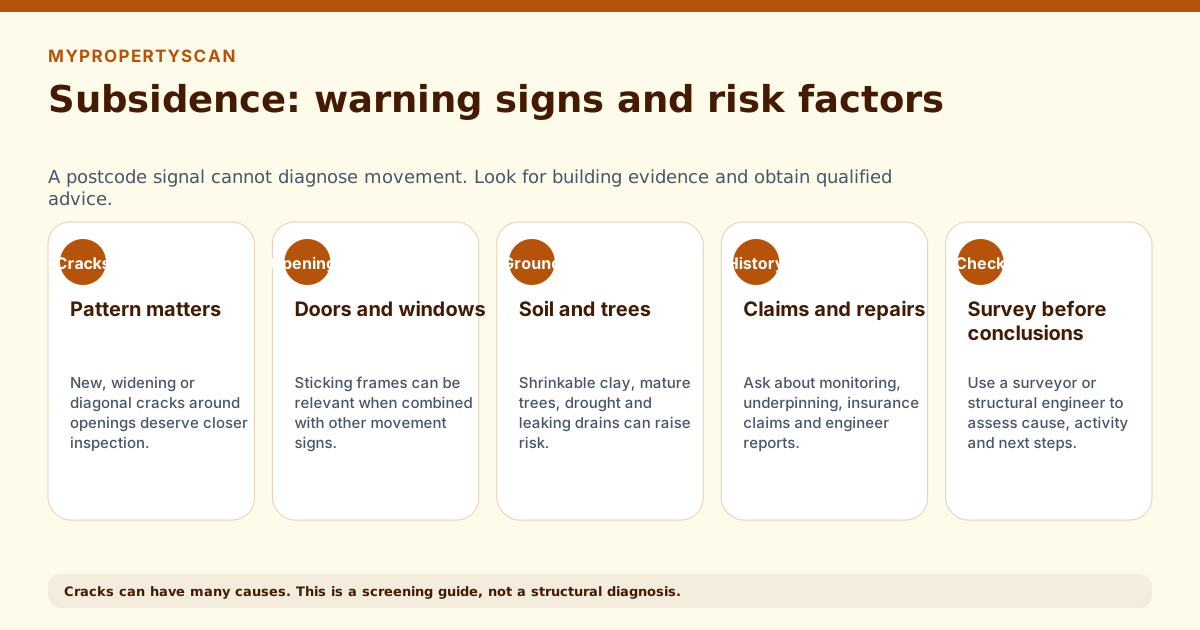
The graphic distinguishes possible warning signs from area-level risk factors and ends with the need for a surveyor or structural engineer rather than a postcode-only conclusion.
What a subsidence risk postcode checker can tell you
A postcode check can flag local clay shrink-swell, historic mining context and address-level prompts to raise with your surveyor. It cannot prove active movement by itself. Use it to decide whether to commission Level 3, structural, drainage or insurance follow-up before exchange.
Ground conditions vary by area: London Clay behaves differently from Sherwood Sandstone in the north-west, and granite around Aberdeen is different again. Our city guides cover 56 UK cities, while the ranked Subsidence Risk Index is a separate, smaller dataset built from BGS GeoSure bands.
What natural ground subsidence means
Natural ground subsidence means downward movement caused by the ground itself, rather than by a mine, basement excavation or poorly compacted fill. BGS GeoSure groups natural ground stability into six hazards: shrink-swell clay, collapsible deposits, compressible ground, landslides, running sand and soluble rocks.
In UK home buying, clay shrink-swell is the best-known example. Clay can lose water and shrink during dry periods, then swell as moisture returns. Trees, leaking drains, foundation depth and building type can change what that geology means for one house. A ground-susceptibility map therefore identifies a hazard that could affect the property; only inspection, monitoring or engineering evidence can show whether the building is moving.
Is there a subsidence claims database?
Not one that a buyer can search by address. The insurance industry's Claims and Underwriting Exchange (CUE) holds home-insurance incidents, including records that may not have become paid claims. MIB's public access route is a subject access request for information about you, not a public property-history search.
Build the property history from evidence instead: ask the seller for previous claim, monitoring, engineer and repair documents; have your conveyancer raise specific enquiries; check the ground-stability and mining searches; and obtain a buildings insurance quote before exchange. If cracks, distortion or past underpinning are disclosed, give the documents to an appropriately qualified surveyor or structural engineer rather than treating a clear map result as proof of no problem.
How to check subsidence risk by postcode
There is no single official subsidence score for an address. Build a screening picture from regional mapping, address-specific searches and property evidence:
- 1Obtain address-specific ground susceptibility where needed. BGS GeoSure is a premium 1:50,000 product; a conveyancing environmental search can supply property-focused ground-stability detail.
- 2Add the mining and made-ground context. Coal, stone, chalk or ironstone workings and poorly compacted made ground can drive movement even where clay risk is low. The city guides below summarise the local picture by area.
- 3Run the address through the scanner above. It combines a directional BGS Engineering Geology indicator at 1:1 million scale with building age and local context, then tells you what to put in front of your surveyor.
For the full buyer playbook, viewing red flags, insurance and mortgage impact, and the negotiation script, read the subsidence risk buying guide.
How to use the local guides
Start with the local guide for the city, then use the address scanner to check the specific postcode. The guide explains the geology and mining context a buyer should know before reading a survey. The address check helps you decide whether the property needs a deeper survey, a structural engineer, a drain survey or a specific question to the seller.
Subsidence pages are separate from flood pages because the buyer workflow is different. Flood risk usually starts with insurance and conveyancing searches. Subsidence risk usually starts with soil, trees, drains, mining history, crack patterns and whether any movement is historic or active.
What a subsidence risk rating means
Any subsidence risk rating describes the ground, not the building. It answers one question: how likely is the soil under this area to shrink and swell enough to move foundations? It does not know whether the house has deep foundations, whether a mature oak sits three metres from the gable, or whether the property has ever moved. Those are survey questions, and no rating substitutes for one.
There are two different scales in play on this site, and they come from two different BGS products. It is worth knowing which one you are looking at.
What the postcode check above returns
One of three results, read from both the surface and bedrock layers: clay-rich ground (shrink-swell prone), clay-rich bedrock below sand or gravel surface deposits, or no clay-rich ground mapped at this scale, which is not an all-clear. If one of the two layers cannot be read, it says only part of the data was read instead. It comes with the BGS engineering geology description for the location, such as “Clay rich, shrink swell prone”, “Mudstone / clay bedrock”, “Sandstone bedrock” or “Sand / gravel”. It is derived from public BGS Engineering Geology at 1:1 million scale, so it is a directional indicator for an area, not parcel-level data and not a graded score.
The city index bands, used in our index and map
A six-point scale summarising BGS GeoSure shrink-swell susceptibility per city. These bands appear in the UK Subsidence Risk Index, which ranks every indexed city and plots them on a clay map at their real coordinates. It is city-wide, so it will not match a specific postcode result exactly. For summer 2026, we also checked every indexed city against the Environment Agency's drought status: see which clay-risk cities are in drought.
| Band | Ground | What a buyer should do |
|---|---|---|
| Very Low / Low | Sands, gravels, chalk or rock with little shrink-swell behaviour. | No specific subsidence action. A standard Level 2 survey covers it. |
| Moderate | Mixed superficial deposits, or clay that is present but not dominant. | Ask the surveyor to comment on crack patterns and tree proximity. Usually no more than that. |
| High | Clay-rich ground that shrinks measurably in a dry summer. | Check for stepped diagonal cracking and mature trees within their height of the wall. Get an insurance quote before exchange. |
| Very High | London, Oxford, Gault or Weald clay: the geologies behind most UK subsidence claims. | Treat a Level 3 survey as the default, and ask the seller directly about past claims and any underpinning. |
Neither scale is address-level. Parcel-level GeoSure susceptibility comes through your conveyancer's environmental search. Insurers then apply their own claims history on top of the geology, which is why two houses on the same clay can be priced differently.
What changes the risk profile
- Clay shrink-swell: high-plasticity clays, mature trees and dry summers are the classic claim pattern.
- Historic mining: coal, chalk, stone or other local workings can matter even where clay risk is low.
- Drainage and foundations: older drains, shallow foundations and local made ground can turn a moderate city-wide risk into a serious address-level question.
Run the check
Check a UK address before you offer, in 15 seconds
Free preview: flood risk, EPC rating, crime, tenure and air quality. The £9.99 report adds the remaining 17 checks, 22 in all, drawing on up to 15 public datasets. Subsidence, from BGS engineering geology, is in the full report.
Run a free previewCities covered
Subsidence risk in London
Greater London
Subsidence risk in Manchester
Greater Manchester
Subsidence risk in Birmingham
West Midlands
Subsidence risk in York
North Yorkshire
Subsidence risk in Bath
Somerset
Subsidence risk in Liverpool
Merseyside
Subsidence risk in Bristol
Bristol
Subsidence risk in Leeds
West Yorkshire
Subsidence risk in Sheffield
South Yorkshire
Subsidence risk in Nottingham
Nottinghamshire
Subsidence risk in Coventry
West Midlands
Subsidence risk in Bradford
West Yorkshire
Subsidence risk in Plymouth
Devon
Subsidence risk in Stoke-on-Trent
Staffordshire
Subsidence risk in Wolverhampton
West Midlands
Subsidence risk in Derby
Derbyshire
Subsidence risk in Swansea
South Wales
Subsidence risk in Southampton
Hampshire
Subsidence risk in Salford
Greater Manchester
Subsidence risk in Reading
Berkshire
Subsidence risk in Aberdeen
Aberdeenshire (Scotland)
Subsidence risk in Milton Keynes
Buckinghamshire
Subsidence risk in Northampton
Northamptonshire
Subsidence risk in Luton
Bedfordshire
Subsidence risk in Sunderland
Tyne and Wear
Subsidence risk in Peterborough
Cambridgeshire
Subsidence risk in Exeter
Devon
Subsidence risk in Oxford
Oxfordshire
Subsidence risk in Cambridge
Cambridgeshire
Subsidence risk in Gloucester
Gloucestershire
Subsidence risk in Kingston upon Hull
East Yorkshire
Subsidence risk in Leicester
Leicestershire
Subsidence risk in Hereford
Herefordshire
Subsidence risk in Shrewsbury
Shropshire
Subsidence risk in Worcester
Worcestershire
Subsidence risk in Lincoln
Lincolnshire
Subsidence risk in Ely
Cambridgeshire
Subsidence risk in Chichester
West Sussex
Subsidence risk in Winchester
Hampshire
Subsidence risk in Newcastle upon Tyne
Tyne and Wear
Subsidence risk in Guildford
Surrey
Subsidence risk in Carlisle
Cumbria
Subsidence risk in Portsmouth
Hampshire
Subsidence risk in Chelmsford
Essex
Subsidence risk in Doncaster
South Yorkshire
Subsidence risk in Norwich
Norfolk
Subsidence risk in Thurrock
Essex
Subsidence risk in Spalding
Lincolnshire
Subsidence risk in Southport
Merseyside
Subsidence risk in Wisbech
Cambridgeshire
Subsidence risk in Hastings
East Sussex
Subsidence risk in Basildon
Essex
Subsidence risk in Canvey Island
Essex
Subsidence risk in Egham
Surrey
Subsidence risk in Skegness
Lincolnshire
Subsidence risk in Harlow
Essex
Frequently asked questions
How do I check subsidence risk by postcode?
MyPropertyScan's instant signal uses public BGS Engineering Geology at 1:1 million scale as a directional indicator, not parcel-level GeoSure data. For address-specific susceptibility, obtain licensed GeoSure data or a conveyancing environmental search. Also check visible crack patterns, distorted doors or windows, nearby trees, drainage and claim history.
What does ground stability by postcode mean?
It means a directional geology description for that area rather than a graded score for one building. Our postcode checker reads two BGS Engineering Geology layers and returns one of three results: clay-rich ground (shrink-swell prone), clay-rich bedrock below sand or gravel surface deposits, or no clay-rich ground mapped at that scale. If one of the two layers cannot be read, it says so rather than giving a result. It describes what the ground is generally made of, such as clay, mudstone, sandstone or sand and gravel. It answers whether the local geology is a subsidence risk factor; it does not know whether any specific building has moved.
Which UK areas have the highest subsidence risk?
London Clay, which covers much of south-east England, is a high-plasticity clay with elevated shrink-swell susceptibility. Boroughs such as Lambeth, Southwark and Lewisham, and parts of Essex and Kent, sit on it. Northern cities founded on harder sandstone and limestone typically have lower risk, though historic coal mining around Yorkshire, the Midlands and South Wales creates separate ground stability concerns.
Does subsidence risk affect insurance?
Insurers price mainly on claims history and evidence of ground movement, not on raw geology alone, so a high shrink-swell area does not automatically mean higher premiums. A property with a documented subsidence history or ongoing monitoring is typically more expensive to insure, and some insurers will not cover the risk until remedial work is verified. Always get a buildings insurance quote for the specific address before exchange.
Does subsidence affect getting a mortgage?
A history of subsidence makes a property harder to mortgage. Lenders require evidence that the cause was identified, remedied and stabilised: typically a structural engineer's report confirming works and a monitored period with no further movement. Buildings insurance for previously subsided properties is also more expensive and some insurers will not cover the risk.
What causes subsidence in UK homes?
The majority of UK subsidence claims are caused by clay shrink-swell: high-plasticity clays shrink in dry summers and swell in wet periods, causing foundation movement. Large trees close to the house accelerate this by drawing moisture from the clay. Other causes include leaking drains washing away soil, historic mine workings, and poorly compacted made ground.
What is natural ground subsidence?
Natural ground subsidence is downward ground movement caused by geological processes rather than mining or construction. BGS GeoSure covers six natural ground-stability hazards: shrink-swell clay, collapsible deposits, compressible ground, landslides, running sand and soluble rocks. A susceptibility result flags the ground conditions; it does not prove that a specific building is moving.
Can I search a subsidence claims database for a property?
There is no public UK database that lets a buyer search every subsidence insurance claim by address. The insurance industry's CUE database holds home-insurance incidents, but MIB provides personal subject access rather than a public property lookup. Ask the seller for claim and repair documents, have your conveyancer raise enquiries, obtain an insurance quote before exchange and investigate any physical warning signs through a surveyor or structural engineer.
Keep going
Related guides
- Buying a house with subsidence
- Bought a house with subsidence
- Subsidence insurance when buying
- Flood risk when buying
- Noise pollution check before buying a house , road and rail noise by postcode for England.
- Air quality check before buying a house , a free PM2.5, nitrogen dioxide and air quality index reading for the address.
- Subsidence monitoring on a survey
How MyPropertyScan produces this guide, and what it is not
Published by MyPropertyScan and written by Ziad Nasr, who is accountable for its accuracy. No page here is written or reviewed by a chartered surveyor, conveyancer or regulated adviser, and we do not claim otherwise.
This page is not:
- Chartered surveying: we do not inspect properties or produce RICS Home Survey reports
- Legal advice: we do not act as conveyancers or advise on title, tenure or contracts
- Mortgage or insurance advice: we are not regulated by the FCA and give no recommendations
Figures and process steps come from the published UK datasets and standards listed on this page, not from professional practice. Pages are updated when source coverage, survey cost assumptions, or lender and legal requirements materially change. Dataset limitations are set out on the methodology page.
Spotted something out of date or wrong? Email [email protected] and we will correct it and change the update date.
Sources used
We use UK public and specialist sources where they are available. Public datasets can be incomplete, delayed, or missing for some addresses. Treat them as a starting point, not as a replacement for professional advice.
Source standard: preference goes to official government datasets, statutory bodies, professional standards, and primary dataset publishers. We cite the source family on the page and explain coverage limits rather than filling gaps with unsupported estimates.
- Check this with: Environment Agency long-term flood risk mapOfficial flood-risk service for England, including river, sea, surface water, reservoir and groundwater where available.
- Data source: HM Land Registry Price Paid DataRegistered residential sale prices for England and Wales.
- Official register: Energy Performance Certificate RegisterPublic EPC certificate lookup for an address, postcode, street or certificate number.
- Data source: British Geological Survey Engineering Geology (1:1 million)National-scale bedrock and superficial-deposit mapping used as a directional ground indicator, not parcel-level GeoSure data or a site investigation.
- Data source: Copernicus CAMS via Open-MeteoCurrent modelled PM2.5, NO₂ and European AQI from a nearby CAMS grid cell.
- Data source: DEFRA Environmental Noise Directive mappingMapped road and rail noise contour data for England, classified into MyPropertyScan's low/moderate/high bands, and separate from the CAMS air-quality source.
- Data source: Police.uk crime dataOpen street-level crime data for England, Wales and Northern Ireland.
- Check this with: Ofcom broadband checkerOfficial checker for broadband availability and speeds.
- Check this with: Ofcom mobile coverage checkerOfficial predicted mobile coverage by network.
- Data source: Food Standards Agency food hygiene ratingsPublic register used to identify nearby food and drink venues.
- Official register: Ofsted inspection reportsSchool and provider inspection report lookup for England. Fee-paying schools come from the DfE Get Information About Schools register, since around half are inspected by ISI and carry no Ofsted grade.
- Official register: Historic England National Heritage ListListed buildings, scheduled monuments and other protected heritage entries in England.
- Ground-stability source: BGS GeoSure shrink-swellThe parcel-scale premium BGS dataset covering clay shrink-swell susceptibility at 1:50,000 scale.
- Claims-data limitation: MIB Claims and Underwriting Exchange subject accessCUE holds home-insurance incident data, but its public route is a subject access request for data about you, not an address-searchable property claims database.
General information only. Not legal, mortgage, insurance, or surveying advice. Always confirm with your own surveyor, broker, and conveyancer before making decisions. MyPropertyScan is operated by BiteRight Ltd.