Survey Costs
Level 3 survey cost UK: Building Survey prices and when it pays back
A RICS Level 3 Building Survey is the detailed option for older, altered, non-standard, or visibly defective homes. This page focuses on Level 3 cost and scope only, so it does not compete with the broader survey-cost comparison page.
Short answer
Most UK Level 3 Building Surveys cost about £650-£2,250+ in 2026. The quote rises with age, size, listed status, non-standard construction, visible defects and regional pricing.
Last updated: 16 July 2026. Editorially reviewed: 16 July 2026.
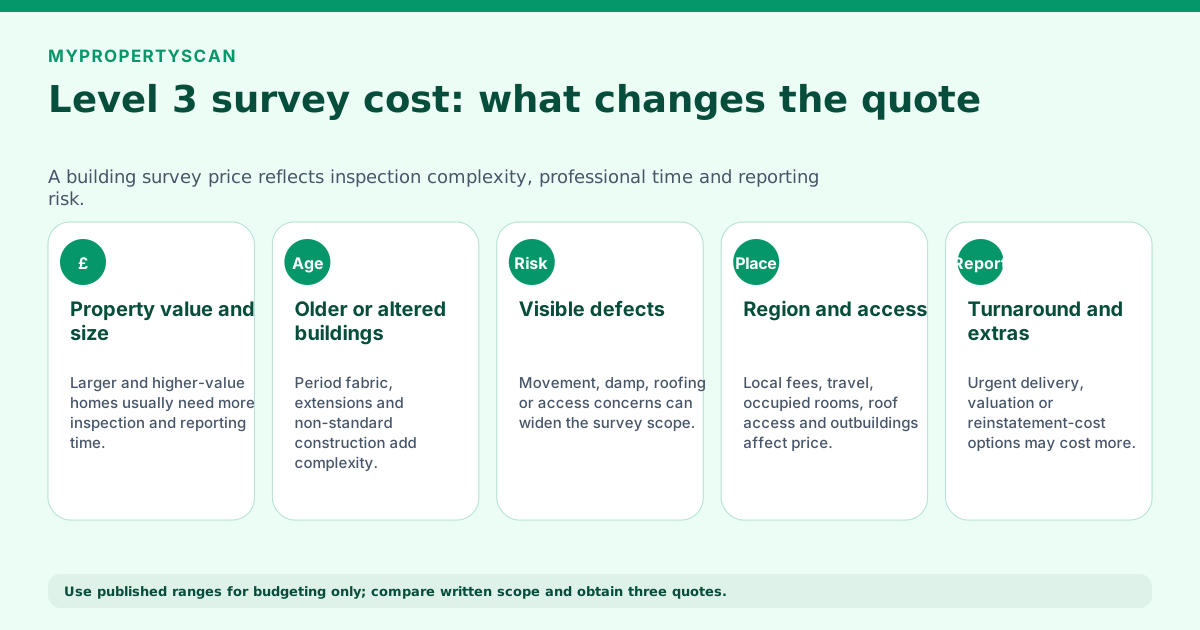
The graphic groups Level 3 cost drivers into property value and size, age and alterations, visible risk, region and access, and reporting turnaround or extras.
Tool shortcut
Run a property check before you commission a survey
Flood, subsidence, EPC, crime, schools, broadband and price data before you spend on the survey.
Run a free previewTypical Level 3 survey prices in 2026
The Level 3 price gap is driven by inspection time, report-writing time, building complexity, and surveyor liability.
| Property type | Typical range | Why it costs more |
|---|---|---|
| Small terrace or maisonette | £650-£950 | Older fabric, shared walls, roof/chimney questions, or access constraints. |
| 3-bed semi | £850-£1,250 | Extensions, bay movement, drainage concerns, or mixed construction phases. |
| 4-bed detached | £1,100-£1,650 | More elevations, roof slopes, outbuildings, and longer report writing. |
| Listed or period property | £1,300-£2,250+ | Specialist knowledge, repair restrictions, and conservation-sensitive defects. |
| Non-standard construction | £1,000-£1,900 | Lender-sensitive construction type, repair history, and structural commentary. |
What the Level 3 fee buys you
Level 3 is not just a longer version of Level 2. The surveyor gives more detailed commentary on construction, likely causes of defects, repair priority, and further investigation. That extra analysis is why it carries more weight when you renegotiate or decide whether to proceed.
- More time on site, often including accessible roof voids and sub-floor areas.
- Detailed commentary on structure, damp causes, roof condition, movement, and alterations.
- Repair advice and prioritisation rather than just condition ratings.
- A more useful paper trail if your lender, insurer, solicitor, or contractor asks what the surveyor found.
When Level 3 is worth the extra cost
- The home is pre-1930, listed, thatched, converted, or built with solid walls.
- There are visible cracks, damp staining, roof deflection, uneven floors, or signs of previous movement.
- The property has a loft conversion, rear extension, removed chimney breast, cellar, basement, or structural alteration.
- The construction is PRC, BISF, Airey, Wimpey No-Fines, timber frame, steel frame, single-skin, or otherwise lender-sensitive.
- You plan major works and need a better baseline before exchange.
Costs that are usually not included
Even Level 3 is still normally non-intrusive. It can recommend specialist reports, but it will not usually include a structural engineer calculation, CCTV drain survey, asbestos sampling, gas safety test, EICR, or damp/timber specialist report. Leave budget for follow-ups if the property is high risk.
How to compare Level 3 quotes
- Ask whether the surveyor has inspected similar properties in that era or construction type.
- Check whether roof voids, cellars, garages, outbuildings, and shared areas are included where accessible.
- Ask how many follow-up questions are included after the report.
- Check whether repair cost guidance is included or only defect descriptions.
- Do not compare purely on price if the cheaper report excludes the risky parts of the property.
Related next steps
Frequently asked questions
How much does a Level 3 survey cost?
A Level 3 Building Survey commonly costs around £650 to £2,250+ depending on property size, value, region, age, and complexity. Large, listed, or unusual homes can exceed that range.
Why is Level 3 more expensive than Level 2?
The surveyor spends longer inspecting and much longer writing up the findings. The report usually includes more diagnosis, repair advice, and building-specific commentary.
Does Level 3 include a valuation?
Not always. Many Level 3 quotes are survey-only, with valuation available for an extra fee. Ask before booking if you need market value advice.
Can Level 3 still recommend more surveys?
Yes. It can still recommend specialist investigations for electrics, drains, asbestos, damp/timber, gas, or structural engineering where the surveyor cannot verify the issue visually.
Run the check before you book
MyPropertyScan gives you a property-risk preview before you spend money on survey follow-ups: flood, subsidence, EPC, building age, listed status, local area, and other buyer checks in one place.
Run the check
Run a property check before you commission a survey
Flood, subsidence, EPC, crime, schools, broadband and price data before you spend on the survey.
Run a free previewEditorial review
Reviewed by the MyPropertyScan editorial team. Editorial owner: BiteRight Ltd, operator of MyPropertyScan. We review buyer guides against UK public property datasets, RICS survey wording, lender requirements, and common buyer questions.
Pages are updated when source coverage, property-risk guidance, survey cost assumptions, or product checks materially change. Methodology and dataset limitations are explained on the MyPropertyScan methodology page.
Sources used
We use UK public and specialist sources where they are available. Public datasets can be incomplete, delayed, or missing for some addresses. Treat them as a starting point, not as a replacement for professional advice.
Source standard: preference goes to official government datasets, statutory bodies, professional standards, and primary dataset publishers. We cite the source family on the page and explain coverage limits rather than filling gaps with unsupported estimates.
- Professional standard: RICS Home Survey StandardRICS standard for condition-based residential surveys in the UK.
- Learn more from: RICS consumer guide to surveysConsumer-facing guide to survey types and when each level is appropriate.
- Official guidance: GOV.UK buying or selling your homeGovernment overview of the home buying and selling process.
General information only. Not legal, mortgage, insurance, or surveying advice. Always confirm with your own surveyor, broker, and conveyancer before making decisions. MyPropertyScan is operated by BiteRight Ltd.