UK Property Buying Guides
Buying guides by property type and era
What goes wrong on a Victorian terrace is different from what goes wrong on a 1930s semi or a new build. Pick the guide that matches the property you're buying. Each one lists common defects, what the survey should cover, which level to book, and what to check before offering.
If you are comparing cities rather than property types, start with our property checks by city directory or use the city directory below. It links directly to every local property-check, flood-risk and subsidence-risk page, so you can find any city from one place.
Last updated: .
MyPropertyScan / UK house-buying guides
Your UK buyer journey, in four field notes
Compare UK house survey costs, check flood risk before buying, find out whether a property is freehold or leasehold, and choose between a Level 2 and Level 3 survey.
01 Field note
UK Level 2 and Level 3 survey costs
Compare typical UK survey costs and the property factors that change a quote.
02 Field note
Flood-risk checks before buying a house
Check flood maps, property history, insurance and conveyancing evidence before you offer.
03 Field note
Freehold or leasehold checker
Check likely tenure, then confirm lease length, title details and buyer risk with your conveyancer.

04 Field note
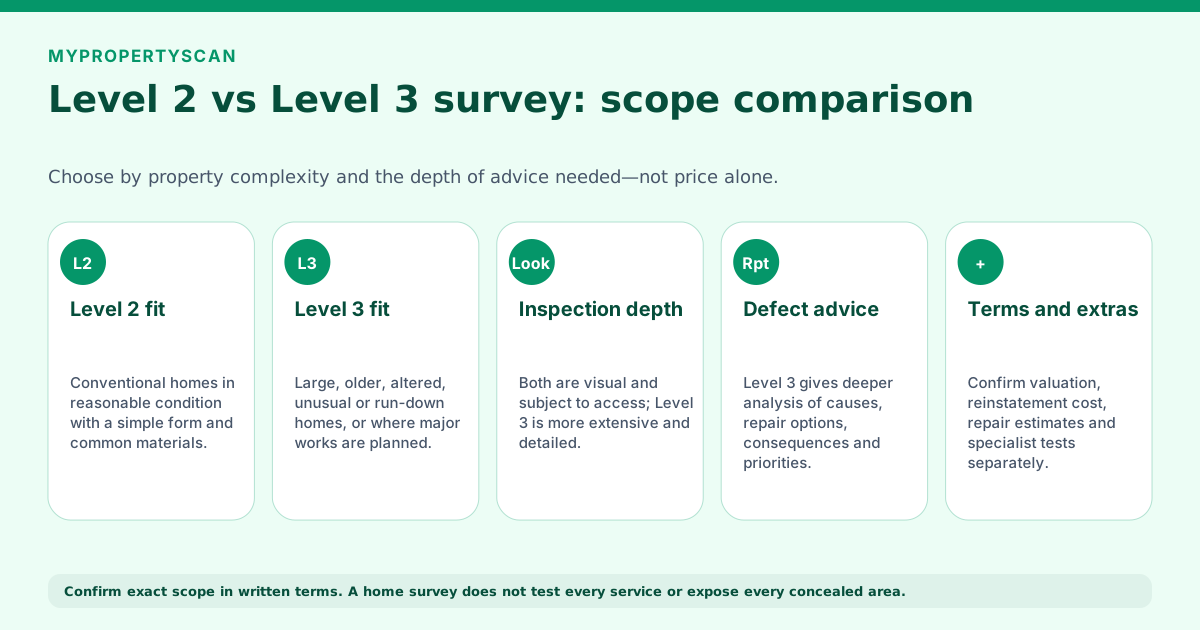
Level 2 vs Level 3 survey: what each covers
Compare property fit, inspection depth, defect advice and the extras to confirm in writing.
Independent UK property guidance. Built for confident buying decisions.
Tool shortcut
Run a property check before you commission a survey
Free preview: flood risk, EPC rating, crime, tenure and air quality. The £9.99 report adds the remaining 17 checks, 22 in all, drawing on up to 15 public datasets.
Run a free previewAvailable guides
Victorian house survey
Victorian houses (built roughly 1837–1901) are still the largest single category of UK pre-war housing stock. Most have been…
1930s house survey
The 1930s semi is the canonical British family house. Build quality varies enormously depending on the developer, with mass-built…
Edwardian house survey
Edwardian houses (built roughly 1901–1914, with the late-Edwardian phase running up to the First World War) sit between the…
1950s house survey
The 1950s housing market was dominated by post-war rebuilding and the local-authority push to address the housing shortage. The…
1960s house survey
The 1960s combined a continuation of post-war rebuilding with the high-rise system-build era. Most 1960s suburban housing was…
1970s house survey
The 1970s was the last decade of large-volume traditional UK housebuilding before regulation tightened on insulation, fire safety…
1980s house survey
1980s housing benefits from tightened Building Regulations on insulation, double glazing as standard, and the disappearance of…
Buying a flat: survey and leasehold issues
Buying a flat in the UK means buying a leasehold (or share of freehold, or commonhold) interest in a building you don't own…
Bungalow survey: what to look for
Bungalows have a different defect profile from two-storey houses. The smaller wall-to-roof ratio means roof condition matters…
Terraced house survey
Terraced houses share at least one party wall with a neighbour, and often share drainage, chimney stacks and roof structure. Many…
Detached house survey
Detached houses are simpler to survey than terraces or semi-detached because the buyer owns and is responsible for everything…
Barn conversion survey
Barn conversions vary enormously in quality. The best are properly engineered, well-insulated, fully serviced and Building Regs…
Buying a listed building
Listed buildings carry specific legal protections that affect what owners can change and how. The listing system has three grades…
Ex-council house survey
Ex-council houses (formerly local-authority-owned, sold under Right to Buy or similar schemes) span every era from inter-war…
New build house survey
New build buyers often assume the developer's warranty replaces the need for a survey. It doesn't. A snagging survey before legal…
Georgian house survey
Georgian houses are some of the most desirable UK period homes, but the survey needs to be more forensic than on later stock. The…
1920s house survey
1920s houses sit between Edwardian solid-wall stock and the more standardised 1930s semi. Some are still solid-wall, some have…
Maisonette survey
A maisonette looks like a halfway point between a flat and a house, but the ownership structure matters more than the name. Some…
Converted flat survey
Converted flats are often more characterful than purpose-built flats, but the survey has to test the quality of the conversion. A…
Basement flat survey
Basement flats need a different survey mindset from upper-floor flats. Below-ground space can be perfectly usable, but only if…
Thatched cottage survey
A thatched cottage is not just a standard period property with a different roof covering. Thatch changes maintenance cycles…
Cob house survey
Cob houses need specialist survey judgement because they do not behave like brick or blockwork. Cob is strong when kept dry and…
Buying a PRC house: survey checklist
This guide is for the buying decision, not a definition of PRC construction. The key question is whether the property has a valid…
Buying a BISF house: survey checklist
A BISF house purchase turns on frame condition, cladding, roof history, lender appetite and insurance comfort. This page keeps the…
Buying a Wimpey No-Fines house
Wimpey No-Fines houses are not PRC, but they are non-standard enough that buyers should check lender appetite, wall condition…
Victorian house in London
Victorian houses (built roughly 1837–1901) are solid-brick, slate or clay-tile-roofed, with suspended timber ground floors and…
Victorian house in Manchester
Victorian houses (built roughly 1837–1901) are solid-brick, slate or clay-tile-roofed, with suspended timber ground floors and…
Victorian house in Birmingham
Victorian houses (built roughly 1837–1901) are solid-brick, slate or clay-tile-roofed, with suspended timber ground floors and…
Victorian house in Leeds
Victorian houses (built roughly 1837–1901) are solid-brick, slate or clay-tile-roofed, with suspended timber ground floors and…
Victorian house in Sheffield
Victorian houses (built roughly 1837–1901) are solid-brick, slate or clay-tile-roofed, with suspended timber ground floors and…
Victorian house in Liverpool
Victorian houses (built roughly 1837–1901) are solid-brick, slate or clay-tile-roofed, with suspended timber ground floors and…
Victorian house in Bristol
Victorian houses (built roughly 1837–1901) are solid-brick, slate or clay-tile-roofed, with suspended timber ground floors and…
Victorian house in Nottingham
Victorian houses (built roughly 1837–1901) are solid-brick, slate or clay-tile-roofed, with suspended timber ground floors and…
Victorian house in Leicester
Victorian houses (built roughly 1837–1901) are solid-brick, slate or clay-tile-roofed, with suspended timber ground floors and…
Victorian house in Bradford
Victorian houses (built roughly 1837–1901) are solid-brick, slate or clay-tile-roofed, with suspended timber ground floors and…
1930s house in London
1930s housing typically uses 50mm cavity walls, hipped or gabled tiled roofs, suspended timber ground floors, and bay windows…
1930s house in Manchester
1930s housing typically uses 50mm cavity walls, hipped or gabled tiled roofs, suspended timber ground floors, and bay windows…
1930s house in Birmingham
1930s housing typically uses 50mm cavity walls, hipped or gabled tiled roofs, suspended timber ground floors, and bay windows…
1930s house in Leeds
1930s housing typically uses 50mm cavity walls, hipped or gabled tiled roofs, suspended timber ground floors, and bay windows…
1930s house in Sheffield
1930s housing typically uses 50mm cavity walls, hipped or gabled tiled roofs, suspended timber ground floors, and bay windows…
1930s house in Liverpool
1930s housing typically uses 50mm cavity walls, hipped or gabled tiled roofs, suspended timber ground floors, and bay windows…
1930s house in Bristol
1930s housing typically uses 50mm cavity walls, hipped or gabled tiled roofs, suspended timber ground floors, and bay windows…
1930s house in Nottingham
1930s housing typically uses 50mm cavity walls, hipped or gabled tiled roofs, suspended timber ground floors, and bay windows…
1930s house in Leicester
1930s housing typically uses 50mm cavity walls, hipped or gabled tiled roofs, suspended timber ground floors, and bay windows…
1930s house in Bradford
1930s housing typically uses 50mm cavity walls, hipped or gabled tiled roofs, suspended timber ground floors, and bay windows…
New build house in London
New builds are governed by current Building Regulations including Part L (energy), Part F (ventilation) and Part B (fire safety)…
New build house in Manchester
New builds are governed by current Building Regulations including Part L (energy), Part F (ventilation) and Part B (fire safety)…
New build house in Birmingham
New builds are governed by current Building Regulations including Part L (energy), Part F (ventilation) and Part B (fire safety)…
New build house in Leeds
New builds are governed by current Building Regulations including Part L (energy), Part F (ventilation) and Part B (fire safety)…
New build house in Sheffield
New builds are governed by current Building Regulations including Part L (energy), Part F (ventilation) and Part B (fire safety)…
New build house in Liverpool
New builds are governed by current Building Regulations including Part L (energy), Part F (ventilation) and Part B (fire safety)…
New build house in Bristol
New builds are governed by current Building Regulations including Part L (energy), Part F (ventilation) and Part B (fire safety)…
New build house in Nottingham
New builds are governed by current Building Regulations including Part L (energy), Part F (ventilation) and Part B (fire safety)…
New build house in Leicester
New builds are governed by current Building Regulations including Part L (energy), Part F (ventilation) and Part B (fire safety)…
New build house in Bradford
New builds are governed by current Building Regulations including Part L (energy), Part F (ventilation) and Part B (fire safety)…
City buyer guides
Each city has three local pages: a full pre-offer property check, a flood-risk guide, and a subsidence-risk guide. The text is based on the city's actual rivers, drainage, geology, mining history and buyer context.
London
Greater London
Manchester
Greater Manchester
Birmingham
West Midlands
York
North Yorkshire
Bath
Somerset
Liverpool
Merseyside
Bristol
Bristol
Leeds
West Yorkshire
Sheffield
South Yorkshire
Nottingham
Nottinghamshire
Coventry
West Midlands
Bradford
West Yorkshire
Plymouth
Devon
Stoke-on-Trent
Staffordshire
Wolverhampton
West Midlands
Derby
Derbyshire
Swansea
South Wales
Southampton
Hampshire
Salford
Greater Manchester
Reading
Berkshire
Aberdeen
Aberdeenshire (Scotland)
Milton Keynes
Buckinghamshire
Northampton
Northamptonshire
Luton
Bedfordshire
Sunderland
Tyne and Wear
Peterborough
Cambridgeshire
Exeter
Devon
Oxford
Oxfordshire
Cambridge
Cambridgeshire
Gloucester
Gloucestershire
Kingston upon Hull
East Yorkshire
Leicester
Leicestershire
Hereford
Herefordshire
Shrewsbury
Shropshire
Worcester
Worcestershire
Lincoln
Lincolnshire
Ely
Cambridgeshire
Chichester
West Sussex
Winchester
Hampshire
Newcastle upon Tyne
Tyne and Wear
Guildford
Surrey
Carlisle
Cumbria
Portsmouth
Hampshire
Chelmsford
Essex
Doncaster
South Yorkshire
Norwich
Norfolk
Thurrock
Essex
Spalding
Lincolnshire
Southport
Merseyside
Wisbech
Cambridgeshire
Hastings
East Sussex
Basildon
Essex
Canvey Island
Essex
Egham
Surrey
Skegness
Lincolnshire
Harlow
Essex
Frequently asked questions
What survey do I need when buying a Victorian house?
A Level 3 Building Survey (formerly Full Structural Survey) is recommended for Victorian properties. These older homes routinely have issues with original cast-iron drains, suspended timber floors with inadequate ventilation, solid walls prone to damp, and single-glazed windows. A Level 2 Homebuyer Report is less thorough and may miss defects common to pre-1900 construction.
Do I need a survey on a new build?
Yes. New builds are covered by an NHBC Buildmark warranty, but this does not replace an independent snagging survey before you move in. Snagging inspections by a RICS surveyor or specialist typically find 50–150 defects on a new property — from incomplete finishes to structural concerns — which the developer must fix before legal completion.
What checks should I do before making an offer on a house?
Before offering, check flood risk, ground conditions, tenure, listed or conservation status, and local planning history. MyPropertyScan's instant ground signal uses public BGS Engineering Geology at 1:1 million scale as a directional indicator, not parcel-level GeoSure data. Obtain GeoSure or a conveyancing environmental search separately when address-specific ground susceptibility matters.
What is different about buying a 1930s house?
1930s semi-detached houses are generally well-built but have specific survey focus areas: steel lintels above windows and doors that can corrode, original parquet or solid wood floors, cavity walls introduced in this era (check cavity wall insulation condition), older electrical installations, and original lead pipework in some properties. Survey Condition Ratings of 2 or 3 for roofing, chimney stacks and electrics are common.
Keep going
Related guides
- House buying checklist , the full pre-offer checklist for any property.
- Survey Decoder , plain-English explanations for any survey finding.
- Level 2 vs Level 3 survey , which RICS survey level to book for which property.
- House survey cost UK , what to expect to pay for Level 2 and Level 3 surveys.
- Your First Home scheme , the England-only scheme for first-time buyers of new-build homes. It has been announced but is not open for applications.
- New-build house prices in England , recorded new-build sale prices by region and council.
How MyPropertyScan produces this guide, and what it is not
Published by MyPropertyScan and written by Ziad Nasr, who is accountable for its accuracy. No page here is written or reviewed by a chartered surveyor, conveyancer or regulated adviser, and we do not claim otherwise.
This page is not:
- Chartered surveying: we do not inspect properties or produce RICS Home Survey reports
- Legal advice: we do not act as conveyancers or advise on title, tenure or contracts
- Mortgage or insurance advice: we are not regulated by the FCA and give no recommendations
Figures and process steps come from the published UK datasets and standards listed on this page, not from professional practice. Pages are updated when source coverage, survey cost assumptions, or lender and legal requirements materially change. Dataset limitations are set out on the methodology page.
Spotted something out of date or wrong? Email [email protected] and we will correct it and change the update date.
Sources used
We use UK public and specialist sources where they are available. Public datasets can be incomplete, delayed, or missing for some addresses. Treat them as a starting point, not as a replacement for professional advice.
Source standard: preference goes to official government datasets, statutory bodies, professional standards, and primary dataset publishers. We cite the source family on the page and explain coverage limits rather than filling gaps with unsupported estimates.
- Check this with: Environment Agency long-term flood risk mapOfficial flood-risk service for England, including river, sea, surface water, reservoir and groundwater where available.
- Data source: HM Land Registry Price Paid DataRegistered residential sale prices for England and Wales.
- Official register: Energy Performance Certificate RegisterPublic EPC certificate lookup for an address, postcode, street or certificate number.
- Data source: British Geological Survey Engineering Geology (1:1 million)National-scale bedrock and superficial-deposit mapping used as a directional ground indicator, not parcel-level GeoSure data or a site investigation.
- Data source: Copernicus CAMS via Open-MeteoCurrent modelled PM2.5, NO₂ and European AQI from a nearby CAMS grid cell.
- Data source: DEFRA Environmental Noise Directive mappingMapped road and rail noise contour data for England, classified into MyPropertyScan's low/moderate/high bands, and separate from the CAMS air-quality source.
- Data source: Police.uk crime dataOpen street-level crime data for England, Wales and Northern Ireland.
- Check this with: Ofcom broadband checkerOfficial checker for broadband availability and speeds.
- Check this with: Ofcom mobile coverage checkerOfficial predicted mobile coverage by network.
- Data source: Food Standards Agency food hygiene ratingsPublic register used to identify nearby food and drink venues.
- Official register: Ofsted inspection reportsSchool and provider inspection report lookup for England. Fee-paying schools come from the DfE Get Information About Schools register, since around half are inspected by ISI and carry no Ofsted grade.
- Official register: Historic England National Heritage ListListed buildings, scheduled monuments and other protected heritage entries in England.
General information only. Not legal, mortgage, insurance, or surveying advice. Always confirm with your own surveyor, broker, and conveyancer before making decisions. MyPropertyScan is operated by BiteRight Ltd.